History of the Streets of Nicosia
Plan Your Trip
The Naming of Streets in Nicosia
The practice of officially naming streets in Nicosia emerged in the early 20th century, reflecting broader changes in urban administration and colonial governance. Prior to 1900, streets bore no formal designations; instead, they were identified informally through distinctive features, professional activities, or prominent families residing in the area. Thus, during the Ottoman and early British periods (up to the late 19th century), references were made to places such as “the street of the blacksmiths,” “Hasan Pasha’s street,” or “at the Serai.”
Following the establishment of British administration in 1878, and particularly in the first decades of the 20th century, systematic methods of urban planning and documentation were gradually introduced. This process culminated after 1923, when the Nicosia Municipality compiled an official register of street and square names. This not only facilitated postal services and municipal organization but also marked a decisive step toward the modernization of the city’s topographical identity.
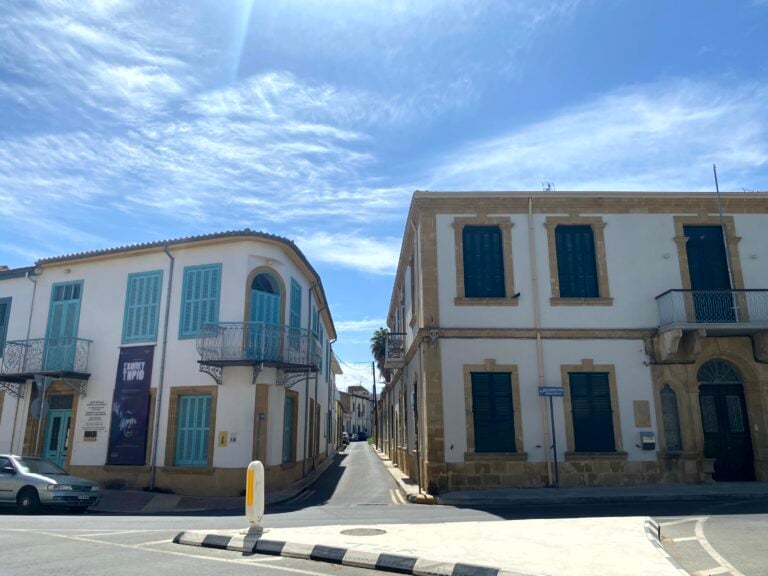
The initial phase of street naming (1920–1930) drew upon a variety of cultural and historical references: ancient Cypriot history, Greek mythology, the commercial role of specific streets, and the toponymy of Cyprus. At the same time, some Ottoman-era names were retained within the walled city, albeit in slightly modified forms (e.g., “Tabakh-hané” becoming “street of the tanners”).
Among the earliest streets to be formally named were Ledra Street, recalling the ancient Cypriot city of Ledra, Onasagorou Street, honoring Onasagoras, king of Salamis, Ermou Street, named after Hermes, the god of commerce, reflecting the area’s bustling trade, Stasandrou Street, commemorating King Stasandros of Kition and Stasinou Street, named for King Stasinos of Salamis. These choices illustrate the interplay of classical heritage, local history, and functional urban identity in the creation of Nicosia’s modern street map.
28 October Square
28 October 1940 is one of Greece's two most important national holidays. On this day, then Prime Minister Ioannis Metaxas rejected the Italian ultimatum demanding the surrender of Greek territory, responding with the historic "NO." The Greek people stood united and heroically resisted the Italian invasion, achieving significant victories on the Albanian front, despite the adverse conditions and the enemy's numerical superiority.
When Italy failed, it sought help from Nazi Germany, which invaded Greece in April 1941. Despite fierce resistance, the country was eventually occupied, and the difficult years of the Occupation began. However, the Greeks did not cease to resist, organizing a guerrilla movement and fighting alongside the Allies until liberation.
This anniversary symbolizes the unity, determination, and love of freedom of the Greek people and remains an important chapter in Greek history.
28TH OCTOBER SQUARE
28th October Square honors the heroic "NO" of 1940, a symbol of unity, resistance, and the timeless love of the Greek people for freedom.
Achilles Street
Achilles, son of King Peleus and the goddess Thetis, was the most celebrated hero of the Trojan War. From a young age, he stood out for his strength, speed, and unmatched courage. His mother, knowing that his fate was to die young if he fought in Troy, tried to protect him, but Achilles could not stay away from glory.
During the siege of Troy, he emerged as a key figure, terrifying the Trojans with his skill and invincible sword. His friendship with Patroclus and the latter’s death at the hands of Hector filled Achilles with uncontainable rage. Driven by renewed determination, he returned to battle, killed Hector, and dragged his body around the city walls, avenging his friend. Despite his glory, fate caught up with him; an arrow shot by Paris, guided by Apollo, struck his heel—the only vulnerable spot—cementing Achilles’ place in the immortality of myth.
Achilles Street was named after the mythical hero, highlighting Cyprus’s connection to the Greek cultural heritage.
Adamantios Korais Street
Adamantios Korais was a Greek philologist with profound knowledge of Greek culture, and one of the leading figures of the Modern Greek Enlightenment. He is remembered, among other things, as a pioneer in publishing works of ancient Greek literature and for his linguistic views, advocating a moderate form of Katharevousa, aiming to purge many foreign words that had entered the language of the people.
He was born on April 27, 1748, in Smyrna and passed away in Paris on April 6, 1833. He was fortunate to grow up in an environment of financial security and scholarly influence, which allowed him to cultivate his love for letters. His first teacher was his mother, one of the few women of the time who knew how to read and write. His innate love of learning was also nurtured by the broader scholarly environment of his family. With the support and financial backing of his father, he began studying French, Italian, as well as Hebrew, Arabic, and Latin—languages particularly useful for his philological pursuits.
Throughout his life, he published a total of 66 volumes of books, of which 17 make up the Greek Library and 9 the Parerga of the Greek Library.
Aeschylus Street
Aeschylus (525–456 BCE), born in Eleusis, is considered the father of ancient Greek tragedy. Of his approximately 90 plays, seven have survived, including The Persians and the Oresteia. He fought in the Persian Wars, and his work reflects the concept of justice and the poet’s responsibility as an engaged citizen. Cyprus, as the birthplace of Aphrodite or as a place of reference, appears in both surviving tragedies and fragments of lost works.
On Aeschylus Street stood the Papadopoulou Theatre, the oldest theatre in Nicosia, built in 1899 with European architectural influences. It hosted theatrical performances from Cyprus and abroad, and in 1907 it staged the city’s first cinema screening. The theatre was a social hub for the elite: men gathered in the smoking room while ladies showcased their fashionable attire. It was later renamed the Melpo Theatre and was demolished in 1968. The Church of Saint Savvas is also located on Aeschylus Street.
Agios Ioannis Street
Agios Ioannis, theologian and evangelist, is one of the most important figures in the Christian faith. A disciple of Christ, he belonged to the inner circle of the twelve Apostles. He is the author of the Gospel of John, the three Catholic Epistles, and the Apocalypse.
This street is home to the historic church of Agios Ioannis, the Pancyprian Gymnasium, and the Museum of Folk Art. The church was built in 1662 by Archbishop Nikiforos of Cyprus on the ruins of an older monastery and until recently served as the city's cathedral. Major ceremonies of the Archdiocese are also held here. It is small, single-aisled with a wooden roof. The exterior is simple in contrast to the interior, which is filled with 18th-century frescoes depicting scenes from the Old and New Testaments. The narrowness of the street and its traditional architecture add warmth and emphasize the historicity of Nicosia's urban landscape.
Agios Maronas Street
There has been a Maronite community in Cyprus for many centuries. The Maronites living in the Republic of Cyprus are equal citizens. Their small community today has a long history and has lived through the adventures and hardships of Cyprus over the last 13 centuries.
Saint Maron is the founder of the Maronite Church and one of the most important figures in Eastern Christianity. A monk and hermit, he is commemorated by the Catholic Church on February 9 and by the Orthodox Church on February 14. He lived a simple, humble life, praying night and day on a mountain in Syria. God gave him the gift of performing many miracles, and his fame spread throughout the surrounding areas. Many people went to meet him. He healed and advised with wisdom, kindness, and love. He spent his days and nights awake and praying "under the canopy of heaven." If the weather worsened, if it got colder and snow fell, he took refuge, not in the ruins of the temple where he celebrated the Divine Liturgy, but in a small tent made of goatskin.
ALCIBIADES ST.
Alcibiades was an Athenian general and politician, intelligent but controversial, who had a strong influence on the Peloponnesian War.